

Why 1:6 Small Groups for IP Students
Why small-group tuition capped at a maximum teacher-to-student ratio of 1:6 works well for IP students: clearer explanations, structured practice, and discussion that builds exam confidence.
The challenge
IP students learn at different paces—large classes cannot keep up
In IP schools such as RGS, Hwa Chong Institution (HCI), RI and NYGH, students move quickly, but not always at the same pace across topics. One-to-one tuition can miss peer discussion, while large classes dilute feedback. Small-group tuition capped at a maximum teacher-to-student ratio of 1:6 gives clearer guidance while keeping lessons interactive.
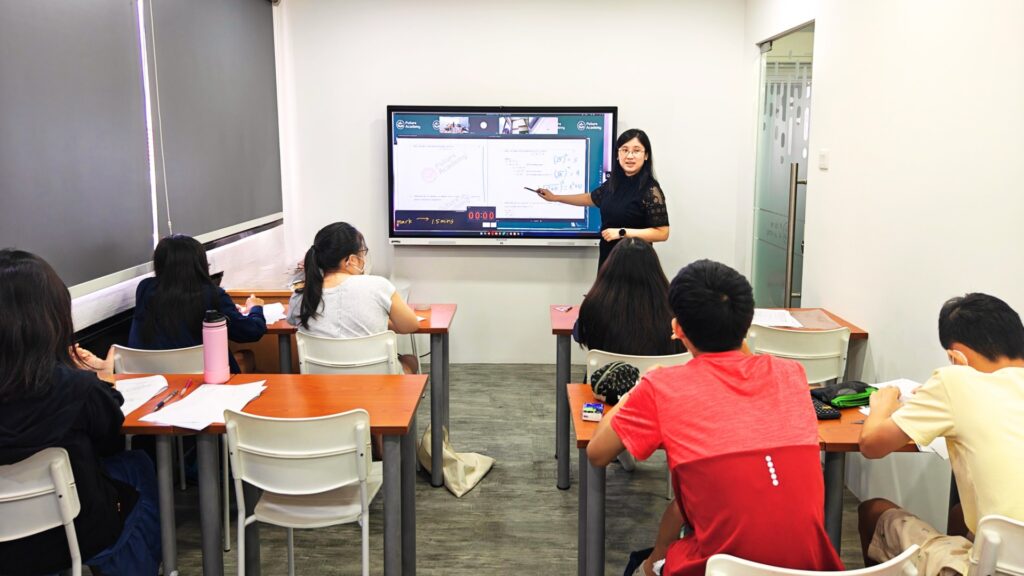
Why small groups work
Individual attention + peer momentum for clearer, more confident IP learning
- Personalised explanations: Misconceptions corrected in-session; multiple approaches until it clicks.
- Real-time monitoring: A maximum teacher-to-student ratio of 1:6 allows frequent check-ins during lessons.
- Differentiated challenge: Extensions for fast learners while others consolidate.
- Peer learning: Multiple solution methods surface; students learn from each other’s questions.
- Healthy competition: Motivating without large-class anxiety.
- School alignment: Group by school where possible for precise curriculum match.
- More teacher access during lessons: Small groups make it easier for students to ask questions early and clarify doubts before misunderstandings compound.
- Confidence building: Safe to ask, test ideas, and learn from mistakes.
Socratic dialogue and multiple perspectives
- Students defend solutions, question assumptions, and build on each other’s reasoning.
- Visual vs algebraic approaches surface side-by-side, strengthening flexible thinking.
- Collaborative problem-solving mirrors IP assessment demands.
Zone of Proximal Development in action
Pairs and triads form naturally: one student a step ahead guides a peer, then roles reverse next topic. Peer teaching deepens mastery for both and keeps everyone at the right level of challenge.
Differentiated teaching within one group
- Multi-level problem sets: Foundation, application, and challenge questions keep everyone engaged.
- Micro-groups: Pair work, individual consolidation, and whole-group debriefs in a single lesson.
- Adaptive pacing: Accelerate when mastered; consolidate when needed with spiral review.
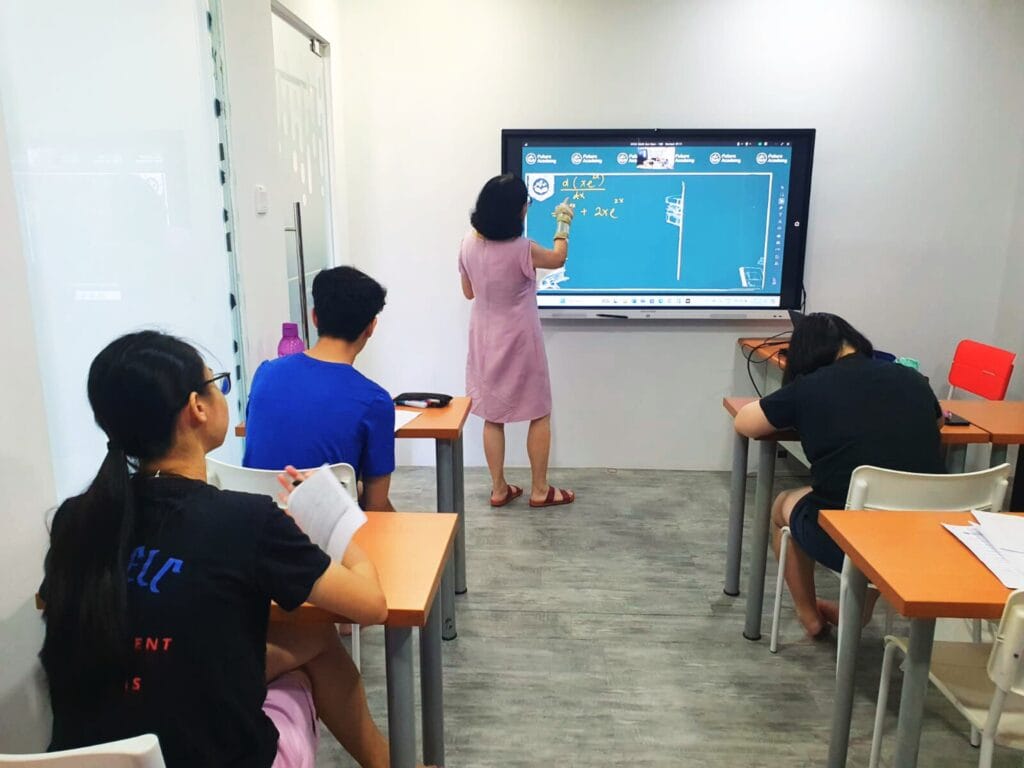
More teacher time where it counts
In a 120-minute class, each student gets ~20 minutes of focused interaction—clarifications, strategy coaching, and metacognitive feedback that lift IP performance.
Conceptual clarity (“why this works”), practical strategies (“how to spot patterns sooner”), and steady encouragement that helps students learn more efficiently and perform more confidently.
Confidence and wellbeing for high achievers
- Safe to make mistakes and ask “can you explain that differently?”
- Growth mindset reinforced by shared struggle on challenging problems.
- Healthy peer community reduces isolation and stress.
What many IP families look for
Many parents look for steady progress, clearer revision routines, and better exam confidence. Students often benefit from consistent teaching standards and classmates who encourage active participation.
Why small groups work for IP students
Cognitive load theory: Smaller groups can reduce distractions and support step-by-step understanding for complex IP content.
Meta-analyses (Glass & Smith; Hattie): Research on class size and small-group instruction suggests learning gains are more likely when classes are kept small and interactive.
Lou et al. (1996): Research on cooperative learning suggests small groups (often around 3–6) can support complex problem-solving when discussion is structured.
Small-group learning: Peer discussion, depth, and individual challenge, delivered in groups capped at a maximum teacher-to-student ratio of 1:6.
School-specific groups supported by our teaching team
Our teaching team: Led by Mr Jason Lau and Ms Yvonne Chen. Teacher allocation depends on timetable and student needs, but lesson standards and materials are consistent across classes.
Our educators: Experienced teachers, including former IP school teachers, guide higher-order problem solving and help students prepare for JC or the IBDP pathway, depending on their school programme.
Grouped by school where possible: RGS, HCI, RI, NYGH, ACSI—aligned pacing, terminology, assessment styles.
Strategic session design
- Aligned to current school topics and marking expectations.
- Depth before breadth; problem-solving focus over drill.
- Connection-building across topics; spiral review for retention.
- Formative checks every class; progress updates for parents.
Why larger IP classes do not work
- Individual attention deficit: 20 students in 120 minutes = ~6 minutes per student—insufficient for IP depth.
- Curriculum misalignment: Mixed-school classes cannot match pacing, emphasis, or assessment styles.
- Lost voices: Many students stay silent; questions go unasked.
- Generic teaching: One pace, one approach, one difficulty level—too blunt for IP learners.
Student experiences in small groups
Book IP lessons in a small group (maximum teacher-to-student ratio of 1:6)
Limited slots. Priority for school-based cohorts (RGS, Hwa Chong, RI, NYGH, ACSI).