
A Level H2 Mathematics

H2 Math Tuition Singapore

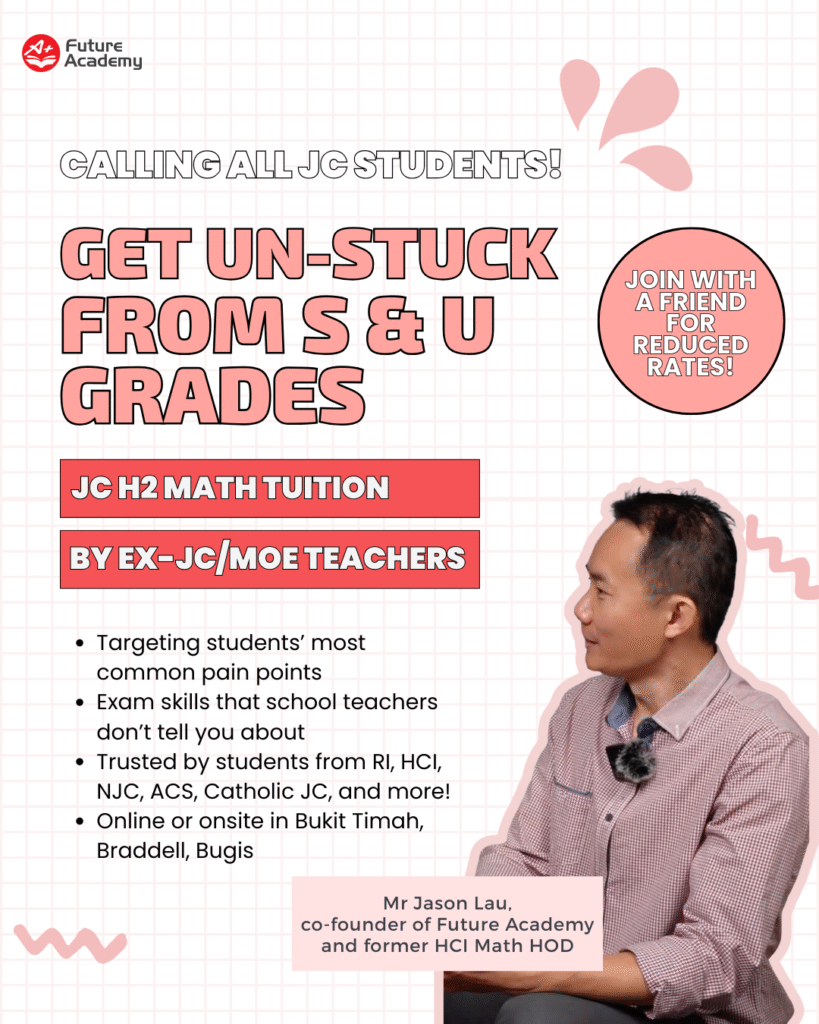
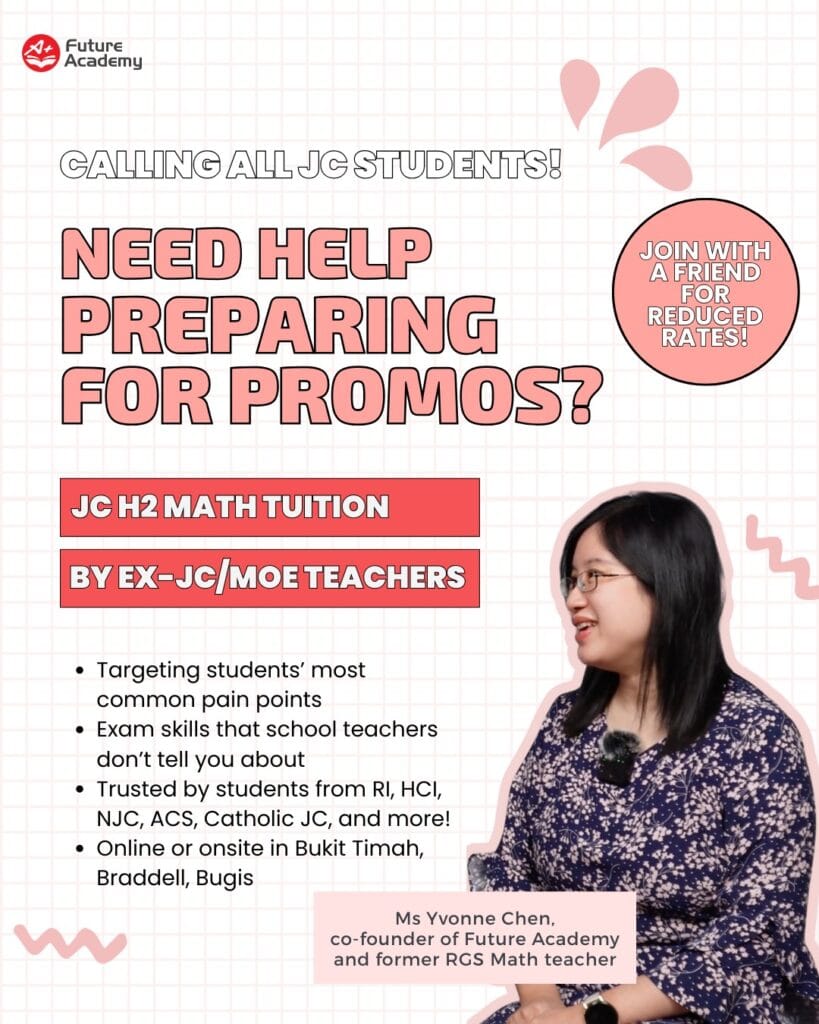
Master H2 Mathematics with our teaching team (led by Mr Jason Lau and Ms Chen). Learn structured methods, handle challenging questions, and improve exam technique. Maximum teacher-to-student ratio of 1:6.

Structured H2 Math support

Learn with a Team Led by Former Hwa Chong Math HOD

H2 Mathematics is a key subject for many JC students, especially those taking the Science stream. It is commonly required for STEM and other quantitative courses. To do well, students need more than memorising formulas or drilling past papers—they need strong concepts, clear working, and consistent practice applying methods to unfamiliar questions.

At Future Academy, our H2 Mathematics programme is delivered by our teaching team, led by Mr Jason Lau and Ms Chen. Our approach focuses on deep understanding, structured methods, and exam-ready problem-solving.

Many students find H2 Math difficult because questions test method choice, rigour and accuracy under time pressure. We teach structured approaches, help students organise their working clearly, and practise exam-style questions so students become more consistent.
The Challenge

What Makes H2 Math Uniquely Demanding

H2 Mathematics differs fundamentally from O Level Additional Mathematics or IP secondary mathematics. The step-up in rigour, abstraction, and problem-solving complexity catches many students unprepared, even those who excelled at lower levels.

  • Conceptual Depth: Understanding principles, not just executing procedures
  • Mathematical Rigour: Complete working with every step justified logically
  • Integration Across Topics: Questions combining multiple concepts in single problems
  • Challenging Questions: Harder parts that require flexible problem-solving
Complete Coverage

The Complete H2 Math Syllabus

H2 Mathematics spans pure mathematics and statistics with extensive content requiring deep understanding. Our systematic curriculum covers all topics comprehensively, building from foundations to examination sophistication.

  • Functions, Graphs & Transformations
  • Sequences & Series
  • Vectors in 2D & 3D Space
  • Complex Numbers & Argand Diagrams
  • Calculus: Differentiation & Integration
  • Differential Equations
  • Probability & Statistics
  • Hypothesis Testing & Sampling
Our Methodology

How we teach H2 Math

Led by a former Hwa Chong Institution Mathematics HOD, our H2 Math teaching team focuses on clear concepts and structured pedagogy. We train concept mastery, answering skills, and problem-solving frameworks aligned to A Level demands—so students learn to handle unfamiliar questions with confidence.

  • Principles before formulas—understanding why methods work
  • Systematic problem analysis and heuristic strategies
  • Multiple solution paths for flexible thinking
  • Handling challenging questions with confidence
1:6 Format

The 1:6 Small Group Advantage for H2 Math

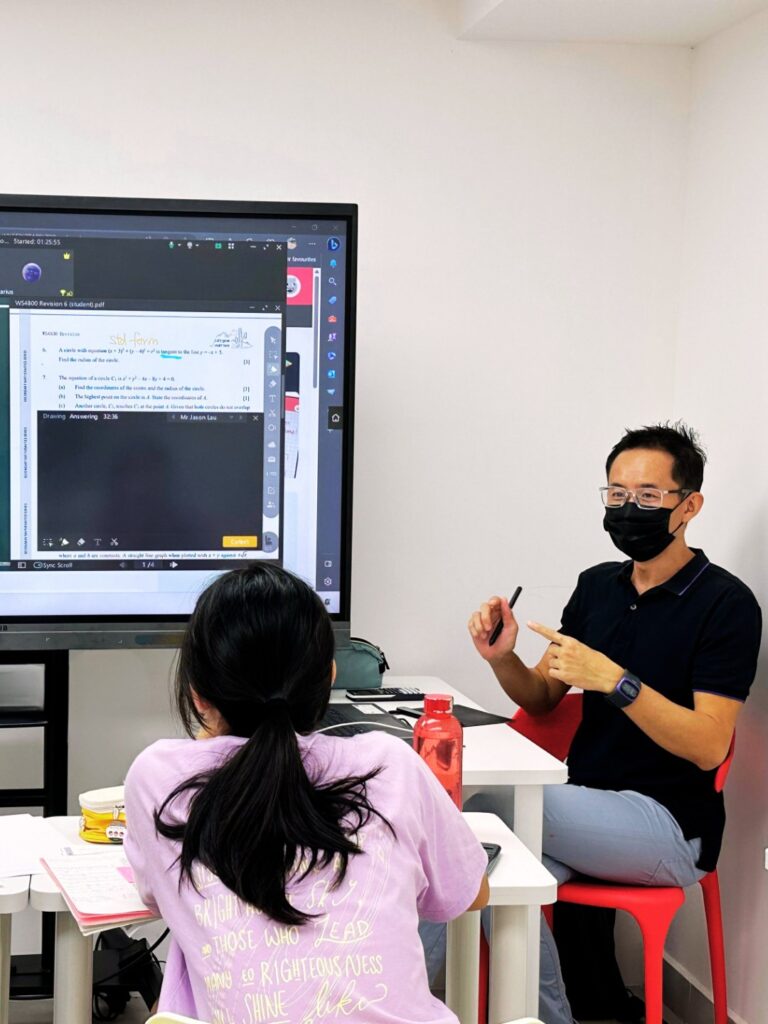
Mathematics learning requires active thinking, not passive observation. Our small-group format (maximum teacher-to-student ratio of 1:6) creates optimal conditions: every student actively problem-solving, immediate feedback on mathematical thinking, collaborative learning through diverse approaches, and personalised challenge appropriate to readiness. With a maximum teacher-to-student ratio of 1:6, there is no hiding—everyone must think, explain reasoning, and demonstrate understanding regularly.
  • Active problem-solving with immediate feedback
  • Mathematical communication development
  • Collaborative problem-solving with peers
  • Cost-effective access to experienced teaching
Questions & Answers

Frequently Asked Questions About H2 Math Tuition

Ideally at the start of JC1. Beginning early allows systematic foundation building before content accumulates. However, students starting in mid-JC1 or even JC2 can still benefit significantly from focused preparation and strategic gap-filling.

Our H2 Math programme is delivered by our teaching team, led by Mr Jason Lau and Ms Chen. The team leads set the curriculum, teaching standards, and lesson structure, while your child’s assigned educator depends on class schedule and level. Regardless of who teaches the class, students learn with the same structured methodology and consistent standards.

Absolutely. Many students who learned IP Mathematics with our teaching team continue seamlessly to H2 Math. Because we build strong foundations early and track progress over time, we can bridge the step-up into JC topics efficiently and reduce gaps when syllabus pace increases.

We organise groups primarily by syllabus coverage (JC1 vs JC2, current topics). Within appropriate groups, students of varied abilities often learn well together—stronger students deepen understanding by explaining concepts while others benefit from peer insights. Our educators adjust the level of challenge for individuals as needed.

The small group format allows our educators to identify specific gaps and provide targeted support. For students with substantial foundational weaknesses, we may recommend additional remediation or temporarily smaller group settings to rebuild basics before rejoining regular groups.

While A Level syllabi are standardized, different JCs maintain distinct teaching approaches. Our team understands these variations and adapts when relevant, while keeping content coverage comprehensive for all students.

Yes, when implemented properly. Our ClassIn platform enables active problem-solving, real-time feedback, and collaborative learning similar to in-person classes. Many students find online learning highly effective for H2 Math while appreciating the time savings.

Typically 1.5-2 hours per week depending on topic difficulty and student needs. Mathematics requires consistent practice, but homework is purposefully assigned to reinforce learning without overwhelming already-busy JC students.

Start Your H2 Math Success Journey Today

Former Hwa Chong HOD | Maximum teacher-to-student ratio of 1:6 | Challenging question strategies

✓ Former Hwa Chong Math HOD   ✓ Maximum teacher-to-student ratio of 1:6   ✓ Strong foundation for STEM courses